Announced Isn’t Realized
Every December, midmarket industrials go through the same ritual. Finance models next year’s costs. Someone proposes a number, usually somewhere between 3 and 5 percent. Leadership debates it, settles on something defensible, and sales sends out a price letter. By February, the increase is considered done. By June, nobody can say how much of it actually showed up in margin.
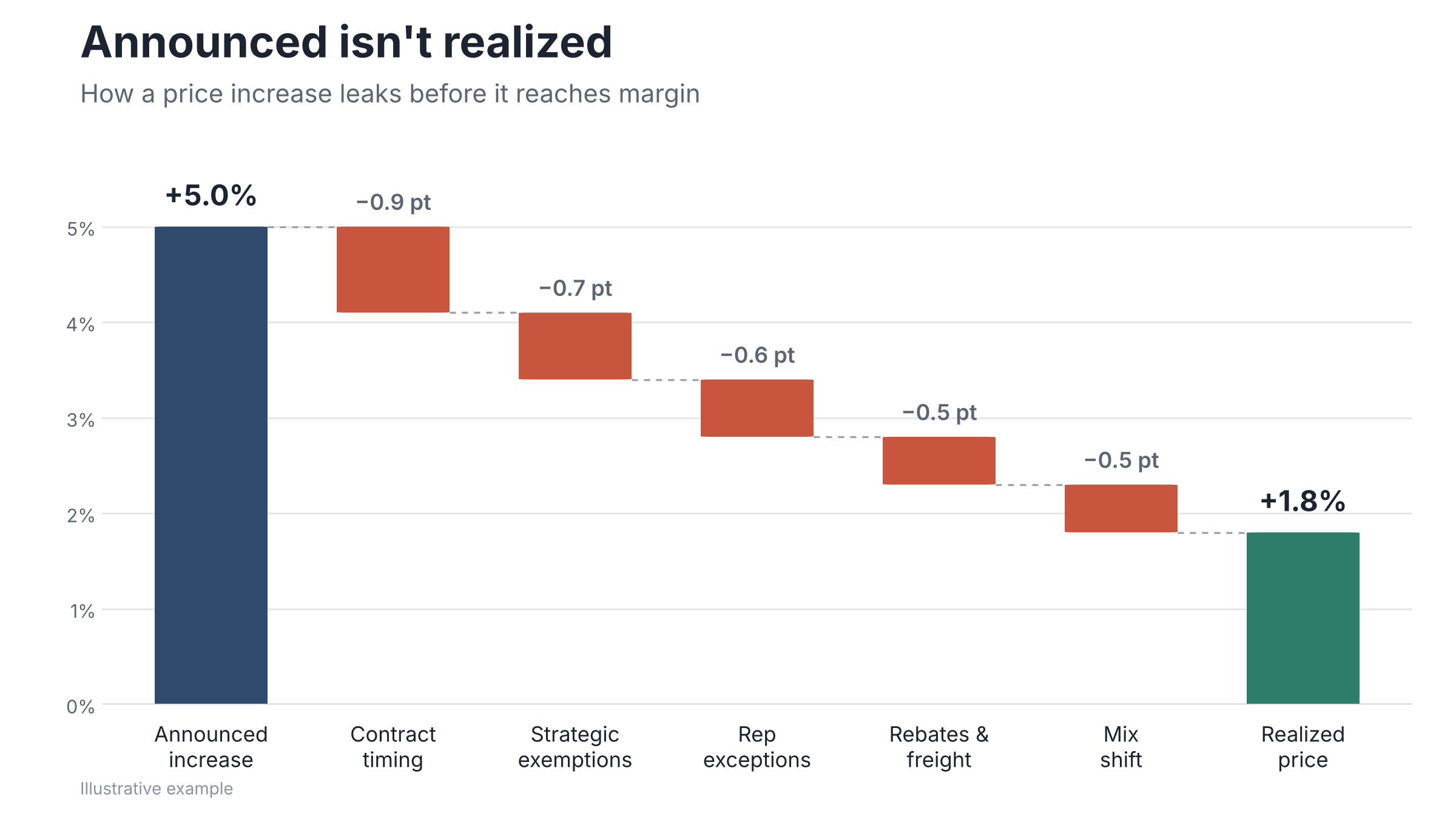
This year the margin for error is thin. Costs are still rising, many industrials are planning increases that barely cover them, and the number in the price letter is the best case. What a company actually collects is almost always less.
The leaks are rarely dramatic. They are dozens of small decisions, each reasonable on its own. Contract customers on annual pricing don’t see the increase until renewal, if then. Strategic accounts get exempted because nobody wants to risk the relationship. Reps grant exceptions to hold volume at their largest customers, often the ones with the most room to absorb an increase. Rebates, special pricing agreements, and freight terms quietly offset part of the change. And as customers trade down or shift volume, mix drifts toward lower-margin products, so average price rises on paper while margin per order does not.
None of this shows up in the price letter, and most of it never shows up in a report. A typical midmarket company tracks invoiced revenue against budget, not realized price against plan by customer and product. So the gap goes unmeasured, and an unmeasured gap is one nobody owns.
Leverage your content to achieve stronger revenue outcomes
The across-the-board increase is a big part of the problem. A uniform number treats every customer and product the same, which guarantees two kinds of waste. It asks too little of customers and products with real pricing power, which is where the money is. And it asks too much of price-sensitive accounts, which is where reps grant the exceptions that erode everything else. The result is an increase that is both too timid and too leaky.
A targeted increase works better. Set it by customer and product based on what each can bear: cost exposure, competitive position, share of wallet, contract terms, and history of accepting increases. That used to take weeks of analysis that most midmarket companies didn’t have the people for. AI now does it across every customer and SKU in hours, with a plain-language reason a rep can repeat in the customer conversation.
Then track what lands. The analysis is the easy part. The value is in the follow-through: loading the new prices into the quote and the ERP so they actually apply, giving reps clear guardrails and a short list of approved exceptions, and comparing realized price to plan every month by account, rep, and product line. When an account comes in below plan, someone has a conversation that week, not at year-end.
The same discipline applies to giving price back. Many industrials passed through surcharges or cost-driven increases in 2026, and as those costs ease, the pressure to roll them back will build. Some relief will be warranted. But a blanket roll-back is the same mistake as a blanket increase. The better question is which customers and products actually need relief, and which have already absorbed the new price without complaint.
This matters more in the midmarket than anywhere else. Large industrials have pricing teams whose job is to chase realization. Most midmarket companies have one pricing person, or none, and a sales team stretched thin. But they also have fewer layers between the decision and the rep, so a targeted increase can be built, explained, and tracked within a single quarter. On a $250 million business, one more point of realized price is $2.5 million of EBITDA, without a new customer or a new plant.
The companies that win 2027 won’t necessarily announce the biggest increase. They will be the ones that set it account by account, put it in their reps’ hands, and know by February how much of it actually landed.
Published November 24, 2026





See What Smarter Pricing Can Do
If your team is buried in data but struggling to turn it into action, you’re not alone. We help transform complex, time-consuming processes into faster, smarter decisions that unlock real revenue growth.